

The Price-to-Earnings (P/E) ratio is one of the most widely used valuation metrics for analyzing whether a stock is fairly priced relative to its earnings, making it a critical tool for investors in the Dhaka Stock Exchange (DSE) and global markets. Building on earlier discussions of Earnings Per Share (EPS) and Net Asset Value (NAV), this article explains how the P/E ratio is calculated, how market price and earnings movements influence it, and why both high and low P/E ratios must be interpreted carefully before making investment decisions. It also highlights the limitations of relying solely on P/E and emphasizes combining it with other financial indicators for accurate stock valuation. To enhance efficiency and accuracy, the article introduces an automated Python-based system that extracts audited financial data from the DSE website, calculates P/E ratios, and ranks listed companies from low to high or high to low, allowing investors to analyze stocks dynamically through CapitalInsightBD’s fundamental analysis platform.
In my previous posts, I discussed key financial indicators such as Earnings Per Share (EPS) and Net Asset Value (NAV), which are essential for evaluating a company’s performance and financial strength. Today, I want to dive into another important metric that should be considered before making investment decisions: the Price-to-Earnings (P/E) ratio.
What is the Price Earnings (P/E) Ratio?
The Price-to-Earnings Ratio is calculated using the following formula:
Price to Earnings Ratio = Current Market Price of Stock / EPS
This ratio shows how many times the current market price of a stock is relative to its earnings. If the market price rises without an increase in EPS, the P/E ratio will increase, potentially indicating the stock is overpriced. Conversely, if the market price remains steady and EPS rises, the P/E ratio will decrease, suggesting the stock may be undervalued.
In short, a lower P/E ratio can signal that a stock is cheaper relative to its earnings, making it potentially attractive for investment. However, it’s crucial to remember that a low P/E ratio does not always mean a stock is a good buy. Investigating any underlying issues or recent negative earnings that might be dragging the ratio down is essential.
Why is the Price to Earnings Ratio Important?
The P/E ratio helps investors assess the price of a stock compared to its earnings capacity. A P/E ratio above zero is typically considered positive, while negative ratios may indicate issues. That said, investors should not solely rely on this ratio but rather combine it with other financial data for well-rounded analysis.
Automating Price to Earnings Ratio Analysis with Python
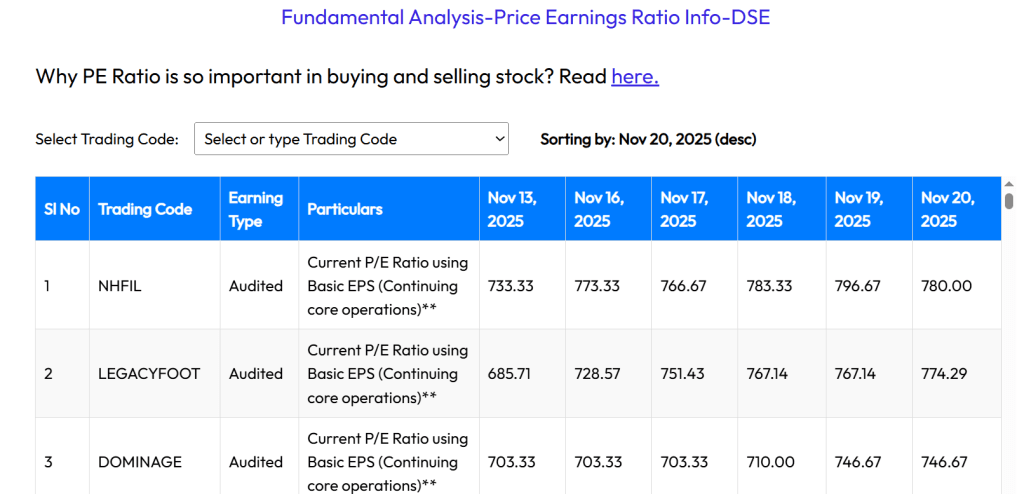
To simplify and expedite the analysis, I have developed a Python script that automates the extraction of key financial metrics, specifically the P/E ratio, from the DSE website using the latest audited financial statements. This script not only retrieves the data but also ranks companies based on their P/E ratios, offering a quick, comprehensive overview. Automation ensures accuracy and efficiency when dealing with a large volume of data.
Discover the chronological order of DSE-listed stocks based on their P/E Ratios (from Low to High or High to Low) effortlessly:
Visit www.capitalinsightbd.com
Navigate to: Menu > Stock Analysis > Fundamental Analysis-Price Earnings Ratio Info-DSE
From there:
Click or tap on column headings (e.g., Jan 12, 2025) to toggle between ascending or descending order.
Use the drop-down menu to select a specific trading code and view detailed information about that stock in a new table below the drop-down.
Below is the screen shot of the Latest PE Ratio of DSE Stock
Stay tuned for more insights as we continue to explore the fundamentals of the Dhaka Stock Exchange.
Written By-Md Kollol Hossain, CEO, CapitalinsightBD
To see the latest Price Earnings Ratio (PE Rato) of the DSE Stock, visit here.
Basic Concept and Terminologies Used in Finance
Investment Banking-Core Concept
This article is for educational purposes only and does not constitute financial or investment advice.
Good writing